
Telehealth & In-Person Appointments. To Provide Quality Care and Protect Patient's Privacy, We Do Not Accept Insurance.

Private, Concierge Psychology Customized for High Performing Professionals, Physicians, Surgeons, & Attorneys

Private, Concierge Psychology Customized for High Performing Professionals, Physicians, Surgeons, & Attorneys

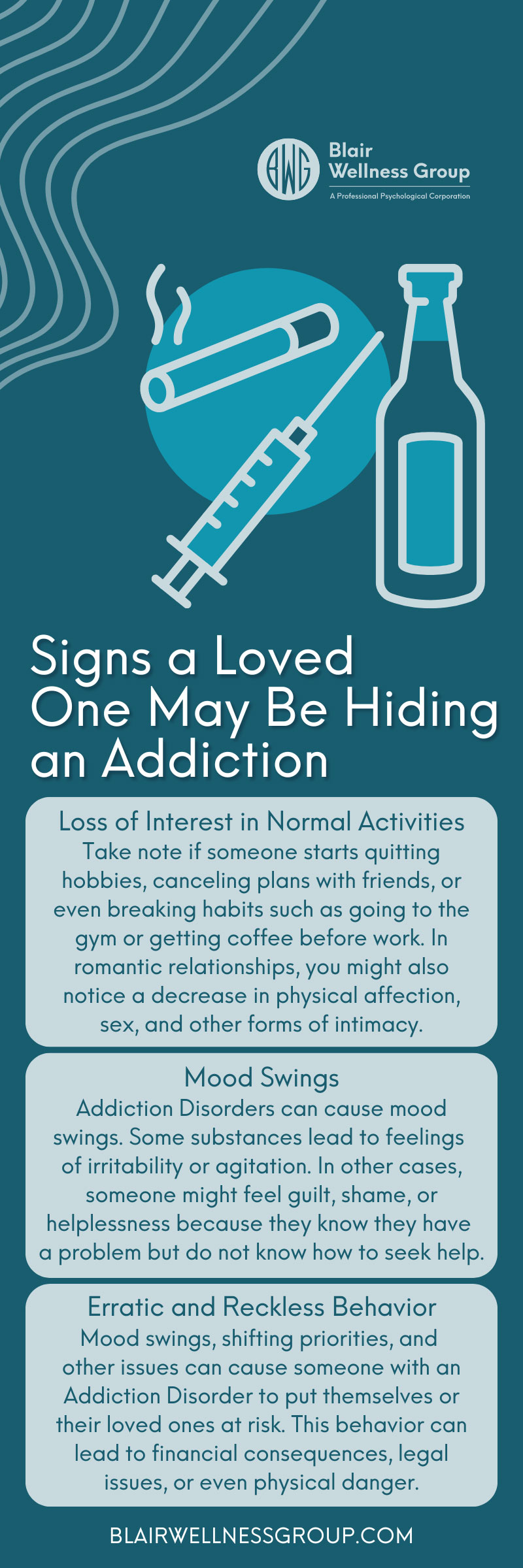
Signs a Loved One May Be Hiding an Addiction

If someone you know has an Addiction Disorder, it impacts your life as well. The symptoms of Addiction Disorders are not always easy to spot early on, but they come to impact every aspect of a person’s life—including their work, hobbies, and relationships. Being able to identify the symptoms of an Addiction Disorder means being able to spot the issue early on and encourage your loved one to seek the help they need. Learn more about the signs a loved one may be hiding an addiction and see how you can help them pursue effective treatment with this guide. 

Physical Symptoms of Addiction 

Addiction comes with physical symptoms as well as mental and emotional symptoms. General physical symptoms include weight fluctuations, consistently low energy, and a clear neglect of personal hygiene. There are also physical symptoms specifically tied to different forms of substance abuse. The precise symptoms will vary depending on the person and what drugs or alcohol they take. Here are a few general examples: 

  • Worsened coordination 
  • Slurred or unusual speech 
  • Pupil dilation 
  • Bloodshot eyes 
  • Wounds or sores on the skin 
  • Bloody nose 
  • Nasal congestion issues 
  • Dental issues 
  • Hand Tremors 
  • Seizures 

These symptoms often appear to come out of nowhere. But over time, the physical signs of Addiction Disorders become more severe and more obvious. Substance Abuse Disorders and other Addiction Disorders pose a serious risk to physical health. Encouraging your loved one to seek Mental Health treatment is a vital step toward preserving both their mental and physical well-being. 

Loss of Interest in Normal Activities 

Like many Mental Health Disorders, Addiction Disorders can sap one’s interest in hobbies, habits, and other activities that used to make up their normal life. Addiction Disorders put the addictive substance or activity at the forefront of the mind. Addiction can take over thoughts and behaviors. Other activities become less enjoyable or interesting compared to the dopamine rush of the object of addiction. 

If your loved one starts to lose interest in things they once enjoyed and prioritized, it is likely a sign that something is affecting their Mental Health. Take note if someone starts quitting hobbies, canceling plans with friends, or even breaking habits such as going to the gym or getting coffee before work. In romantic relationships, you might also notice a decrease in physical affection, sex, and other forms of intimacy. 

Mood Swings 

There are many reasons why Addiction Disorders can cause mood swings. Some substances lead to feelings of irritability or agitation. In other cases, someone might feel guilt, shame, or helplessness because they know they have a problem but do not know how to seek help. Moreover, Mental Health Conditions can worsen one’s ability to modulate affect, making it harder to process and deal with emotions in a healthy and productive way. 

Mood swings are another common sign of many different Mental Health Disorders, including Mood Disorders and Personality Disorders, which are commonly comorbid with Addiction Disorders.  

Erratic and Reckless Behavior 

Addiction Disorders affect one’s thoughts, emotions, and priorities. Because of that, they also have a serious effect on behavior. Atypical behavior is a common sign that a loved one may be hiding an addiction.  

In some cases, this abnormal behavior can turn impulsive, reckless, and even violent. Mood swings, shifting priorities, and other issues can cause someone with an Addiction Disorder to put themselves or their loved ones at risk. This behavior can lead to financial consequences, legal issues, or even physical danger. 

Withdrawing From Normal Daily Activities 

Addiction Disorders often cause people to pull away from their loved ones and act as if they no longer have any interest in normal daily activities. They might cancel plans or seem distant in conversations. When they do spend time with friends or family, they might act as if they are bored or not enjoying themselves, which can lead to arguments or discord. 

They withdraw from daily activities. This withdrawal makes them seem even more distant and uncaring, causing tension and strain at work and in intimate relationships.  

In situations like these, improving the relationship must begin with improving Mental Health. With expert treatment from a Licensed Clinical Psychologist, your loved one can gain clarity and control over their thoughts, emotions, and behaviors. This treatment puts them in a better position to address and fix problems in your relationship. 

Changes in Habits and Routines 

If your loved one starts breaking habits or changing their routine with no explanation, it might be because of an Addiction Disorder. Addiction can change someone’s exercise routine or eating habits. It can also lead to abnormal sleep patterns and problems such as insomnia. 

Alternatively, they might start hanging out with different people or visiting different places. Habit changes and other abnormal behaviors can be tricky signs to spot because they look different in everybody. If you notice strange changes or behaviors in your loved one, it is often best to talk to them. See if you can learn more about the issue. If necessary, encourage them to seek professional intervention and treatment. 

Withdrawal Symptoms 

Withdrawal occurs when someone stops using addictive substances after becoming reliant on them. If someone tries to hide their addiction or quit abusing substances without telling anyone, they will likely show withdrawal symptoms.  

These symptoms can include mental or emotional issues such as paranoia, anxiety, mood swings, listlessness, and depression. They can also include physical signs such as sweating, muscle aches, clammy skin, and nausea.  

Your loved one might try to hide their withdrawal symptoms or pass them off as another issue, such as the flu or another physical sickness. However, if these withdrawal symptoms arise alongside other indicators of addiction, there is a good chance that your loved one is suffering from an Addiction Disorder. 

Blair Wellness Group Offers Effective Treatment 

Taking the first step toward treatment and contacting a Licensed Clinical Psychologist is not always easy, but it is necessary for regaining control and improving Mental Health and overall well-being. If you or a loved one are looking for an Addiction Therapist in LA, in Irvine, Beverly Hills, Newport Beach, Bel Air, Century City, Brentwood, Westwood, Huntington Beach, Mission Viejo, Aliso Viejo, and the surrounding areas, contact Blair Wellness Group to see how our evidence-based treatment plans can help you. 
Licensed Clinical Psychologist & Performance Coach for C-Suite Executives & Professionals at  | Website |  + posts

Dr. Cassidy Blair is a renowned Licensed Clinical Psychologist and trusted Performance Coach who specializes in providing Concierge-Psychological Care and Executive Coaching for high-achieving professionals. With a deep understanding of the unique challenges faced by CEOs, executives, entrepreneurs, and leaders, Dr. Blair offers tailored, confidential care designed to foster emotional well-being, personal growth, and professional excellence. Her clientele values her discretion, clinical expertise, and emotionally intelligent approach to navigating complex personal and professional dynamics.


Related Blog

Agoraphobia in High-Pressure Professionals

For many high-functioning professionals, success is built on precision, control, and the ability to perform under pressure. Executives, entrepreneurs, physicians, and attorneys are accustomed to managing complex systems, leading teams, and making critical decisions with confidence. When anxiety begins to quietly restrict movement, travel, or engagement with the outside world, it often creates profound internal

Young lawyer waits in the lobby at Blair Wellness Group for his relationship counseling appointment.

Reactive Attachment Disorder & Disinhibited Social Engagement Disorder (DSED) in Adults

High-achieving professionals often excel in environments that reward independence, decisiveness, and emotional control. Executives, entrepreneurs, physicians, and attorneys are accustomed to relying on logic and performance rather than emotional needs. Yet for some, early relational disruptions continue to shape adult relationships, stress tolerance, and emotional intimacy in ways that are difficult to name or understand.

Seasonal Affective Disorder – Understanding Its Impact

Even in sunny Southern California, high-achieving professionals, such as CEOs, executives, entrepreneurs, attorneys, and physicians, are not immune to the emotional and cognitive challenges associated with Seasonal Affective Disorder (SAD). While many assume that this disorder primarily affects individuals in colder, darker climates, fluctuations in daylight, changes in routine, and environmental stressors can trigger symptoms

Looking for a Local Psychologist?

Our Psychologists and Therapists in Los Angeles, Beverly Hills, Irvine, Newport Beach, and the surrounding areas offer evening and weekend appointments for our Concierge patients. Contact us today to discover how Blair Wellness Group can help you overcome personal or professional challenges and mental health disorders, such as depression, anxiety, relationship challenges, addiction issues, and personality disorders. 

Scroll to Top

Request An Appointment

var gform;gform||(document.addEventListener("gform_main_scripts_loaded",function(){gform.scriptsLoaded=!0}),document.addEventListener("gform/theme/scripts_loaded",function(){gform.themeScriptsLoaded=!0}),window.addEventListener("DOMContentLoaded",function(){gform.domLoaded=!0}),gform={domLoaded:!1,scriptsLoaded:!1,themeScriptsLoaded:!1,isFormEditor:()=>"function"==typeof InitializeEditor,callIfLoaded:function(o){return!(!gform.domLoaded||!gform.scriptsLoaded||!gform.themeScriptsLoaded&&!gform.isFormEditor()||(gform.isFormEditor()&&console.warn("The use of gform.initializeOnLoaded() is deprecated in the form editor context and will be removed in Gravity Forms 3.1."),o(),0))},initializeOnLoaded:function(o){gform.callIfLoaded(o)||(document.addEventListener("gform_main_scripts_loaded",()=>{gform.scriptsLoaded=!0,gform.callIfLoaded(o)}),document.addEventListener("gform/theme/scripts_loaded",()=>{gform.themeScriptsLoaded=!0,gform.callIfLoaded(o)}),window.addEventListener("DOMContentLoaded",()=>{gform.domLoaded=!0,gform.callIfLoaded(o)}))},hooks:{action:{},filter:{}},addAction:function(o,r,e,t){gform.addHook("action",o,r,e,t)},addFilter:function(o,r,e,t){gform.addHook("filter",o,r,e,t)},doAction:function(o){gform.doHook("action",o,arguments)},applyFilters:function(o){return gform.doHook("filter",o,arguments)},removeAction:function(o,r){gform.removeHook("action",o,r)},removeFilter:function(o,r,e){gform.removeHook("filter",o,r,e)},addHook:function(o,r,e,t,n){null==gform.hooks[o][r]&&(gform.hooks[o][r]=[]);var d=gform.hooks[o][r];null==n&&(n=r+"_"+d.length),gform.hooks[o][r].push({tag:n,callable:e,priority:t=null==t?10:t})},doHook:function(r,o,e){var t;if(e=Array.prototype.slice.call(e,1),null!=gform.hooks[r][o]&&((o=gform.hooks[r][o]).sort(function(o,r){return o.priority-r.priority}),o.forEach(function(o){"function"!=typeof(t=o.callable)&&(t=window[t]),"action"==r?t.apply(null,e):e[0]=t.apply(null,e)})),"filter"==r)return e[0]},removeHook:function(o,r,t,n){var e;null!=gform.hooks[o][r]&&(e=(e=gform.hooks[o][r]).filter(function(o,r,e){return!!(null!=n&&n!=o.tag||null!=t&&t!=o.priority)}),gform.hooks[o][r]=e)}});

document.getElementById( "ak_js_1" ).setAttribute( "value", ( new Date() ).getTime() );
  • This field is for validation purposes and should be left unchanged.
  • MM slash DD slash YYYY
  • Cancellation/Refund Policy:

    Please note, there are absolutely no refunds for any of your prepaid sessions in case of broken appointments by you as the professional times and days were reserved for you and will be considered as broken appointments. We ask that you do not make appointments unless you fully intend to keep all your future weekly appointments as we do not issue refunds on ANY prepaid appointment. Please note, our practice is fully committed based on previously scheduled times for our clients at least 2 weeks in advance.
  • Clear Signature
gform.initializeOnLoaded( function() {gformInitSpinner( 4, 'https://blairwellnessgroup.com/wp-content/plugins/gravityforms/images/spinner.svg', true );jQuery('#gform_ajax_frame_4').on('load',function(){var contents = jQuery(this).contents().find('*').html();var is_postback = contents.indexOf('GF_AJAX_POSTBACK') >= 0;if(!is_postback){return;}var form_content = jQuery(this).contents().find('#gform_wrapper_4');var is_confirmation = jQuery(this).contents().find('#gform_confirmation_wrapper_4').length > 0;var is_redirect = contents.indexOf('gformRedirect(){') >= 0;var is_form = form_content.length > 0 && ! is_redirect && ! is_confirmation;var mt = parseInt(jQuery('html').css('margin-top'), 10) + parseInt(jQuery('body').css('margin-top'), 10) + 100;if(is_form){jQuery('#gform_wrapper_4').html(form_content.html());if(form_content.hasClass('gform_validation_error')){jQuery('#gform_wrapper_4').addClass('gform_validation_error');} else {jQuery('#gform_wrapper_4').removeClass('gform_validation_error');}setTimeout( function() { /* delay the scroll by 50 milliseconds to fix a bug in chrome */ jQuery(document).scrollTop(jQuery('#gform_wrapper_4').offset().top - mt); }, 50 );if(window['gformInitDatepicker']) {gformInitDatepicker();}if(window['gformInitPriceFields']) {gformInitPriceFields();}var current_page = jQuery('#gform_source_page_number_4').val();gformInitSpinner( 4, 'https://blairwellnessgroup.com/wp-content/plugins/gravityforms/images/spinner.svg', true );jQuery(document).trigger('gform_page_loaded', [4, current_page]);window['gf_submitting_4'] = false;}else if(!is_redirect){var confirmation_content = jQuery(this).contents().find('.GF_AJAX_POSTBACK').html();if(!confirmation_content){confirmation_content = contents;}jQuery('#gform_wrapper_4').replaceWith(confirmation_content);jQuery(document).scrollTop(jQuery('#gf_4').offset().top - mt);jQuery(document).trigger('gform_confirmation_loaded', [4]);window['gf_submitting_4'] = false;wp.a11y.speak(jQuery('#gform_confirmation_message_4').text());}else{jQuery('#gform_4').append(contents);if(window['gformRedirect']) {gformRedirect();}}jQuery(document).trigger("gform_pre_post_render", [{ formId: "4", currentPage: "current_page", abort: function() { this.preventDefault(); } }]); if (event && event.defaultPrevented) { return; } const gformWrapperDiv = document.getElementById( "gform_wrapper_4" ); if ( gformWrapperDiv ) { const visibilitySpan = document.createElement( "span" ); visibilitySpan.id = "gform_visibility_test_4"; gformWrapperDiv.insertAdjacentElement( "afterend", visibilitySpan ); } const visibilityTestDiv = document.getElementById( "gform_visibility_test_4" ); let postRenderFired = false; function triggerPostRender() { if ( postRenderFired ) { return; } postRenderFired = true; gform.core.triggerPostRenderEvents( 4, current_page ); if ( visibilityTestDiv ) { visibilityTestDiv.parentNode.removeChild( visibilityTestDiv ); } } function debounce( func, wait, immediate ) { var timeout; return function() { var context = this, args = arguments; var later = function() { timeout = null; if ( !immediate ) func.apply( context, args ); }; var callNow = immediate && !timeout; clearTimeout( timeout ); timeout = setTimeout( later, wait ); if ( callNow ) func.apply( context, args ); }; } const debouncedTriggerPostRender = debounce( function() { triggerPostRender(); }, 200 ); if ( visibilityTestDiv && visibilityTestDiv.offsetParent === null ) { const observer = new MutationObserver( ( mutations ) => { mutations.forEach( ( mutation ) => { if ( mutation.type === 'attributes' && visibilityTestDiv.offsetParent !== null ) { debouncedTriggerPostRender(); observer.disconnect(); } }); }); observer.observe( document.body, { attributes: true, childList: false, subtree: true, attributeFilter: [ 'style', 'class' ], }); } else { triggerPostRender(); } } );} );