

To Provide Quality Care and Protect Patient's Privacy, We Do Not Accept Insurance.

Concierge Psychology Exclusively Tailored for the Clinical Needs and Coaching Demands of Professional Men, Executives, Entrepreneurs, Attorneys, Physicians & Surgeons

Ways That Bulimia Nervosa Can Damage Your Body

Bulimia Nervosa is one of the most common Eating Disorders. Like all Eating Disorders, Bulimia causes severe mental and emotional distress. Low self-esteem, an unhealthy preoccupation with body weight, isolation, or feelings of guilt are just some examples of the negative effects Bulimia has on your thoughts, behaviors, and emotions.

However, there are also many physical symptoms of Bulimia. Individuals who don’t seek professional mental health treatment for their Eating Disorder experience both short- and long-term physical consequences. Bulimia affects the entire body, and the longer you go without treatment, the more damage you will sustain. Read on to learn about the ways that Bulimia Nervosa can damage your body and see why it’s important to seek professional help.

The Dangers of Binging and Purging

Bulimia Nervosa revolves around the acts of binging and purging. Binging is the act of overindulging by eating an excess amount of food, often to the point of discomfort. To counteract this, people with Bulimia will then purge through behaviors such as self-induced vomiting or taking laxatives.

Both binge eating and purging have serious consequences for the body. From short-term effects such as a sore throat from vomiting to long-term complications like chronic digestive issues, binging and purging take a toll on your physical health. Unfortunately, these symptoms are just the beginning of the damage that Bulimia can cause. It’s important to take the physical consequences of Bulimia Nervosa as a serious sign to seek help from a Licensed Clinical Psychologist who specializes in Eating Disorders.

Damage to the Digestive System

Digestive issues are among the most common ways that Bulimia Nervosa can damage your body. The cycle of binge eating and purging wreaks havoc on your mouth, throat, stomach, and intestines.

Digestive symptoms show up early and can be an obvious initial sign of the physical harm Bulimia causes. Early issues include a sore throat or stomach pain as a result of self-induced vomiting. As the Eating Disorder continues, these symptoms can worsen to even more severe and threatening conditions.

Individuals who purge through self-induced vomiting will experience issues in the throat and esophagus. Damage to the esophagus can range from irritation to tears that create lasting damage. Chronic vomiting can also rupture the esophagus and cause bloody vomit and other complications.

Those who purge by using diuretics or laxatives will likely experience kidney damage, hemorrhoids, and long-term complications with bowel movements.

There are also many stomach issues that stem from Bulimia, including irritation and stomachaches. Heartburn, acid reflux, bloating, diarrhea, or constipation can also occur because of binging and purging behaviors.

Dehydration and Electrolyte Imbalances

Purging leads to a loss of fluids, which causes a wide range of complications for the body. Most notably, purging can cause severe dehydration, leaving you weak and fatigued.

Individuals with Bulimia also frequently suffer from electrolyte imbalances. Dehydration causes you to lose necessary electrolytes, such as sodium and potassium. In turn, this loss puts strain on your blood vessels, heart, and other organs. Resulting heart problems include an irregular heartbeat, also known as arrhythmia, a weaker heart muscle, and even heart failure, which can prove fatal in severe cases.

Hormonal and Reproductive Issues

Bulimia Nervosa can create nutritional deficiencies that have a wide range of consequences throughout the body. A lack of nutrients causes issues with hormones, menstruation, reproduction, and more. Women with Bulimia often experience irregular periods or stop having their periods altogether. These hormonal imbalances can also lead to fertility issues, such as ovaries no longer releasing eggs.

Pregnant women are also at risk of serious physical consequences stemming from Bulimia. Pregnancy complications caused by Bulimia include:

  • Maternal high blood pressure
  • Higher risk of cesarean delivery
  • Gestational diabetes
  • Babies with low birth weights
  • Birth defects
  • Miscarriage
  • Trouble breastfeeding

The physical consequences of Bulimia put both mothers and their babies at risk during and after pregnancy.

Dental Issues and Other Damage to the Mouth

Individuals who purge through self-induced vomiting also must contend with dental issues. Stomach acid damages tooth enamel and can lead to discoloration and tooth decay. Many individuals with Bulimia also experience complications like gum disease, sores within the mouth, and swollen salivary glands.

Circulatory Issues

Bulimia Nervosa also poses a threat to your circulatory system. Dehydration, a lack of nutrition, weak muscles, and severe fatigue stemming from Bulimia can cause a variety of dangerous problems.

One example is low blood pressure. Binging and purging can cause your blood pressure to drop to the point of fainting. You might also experience a weakened pulse, anemia, or a drop in body temperature due to poor circulation.

Lack of Nutrients in Hair, Skin, and Nails

Bulimia Nervosa also affects the integumentary system, which includes hair, skin, and nail glands. A lack of nutrients from purging behaviors can cause dry or frizzy hair, rough skin, brittle nails, and other issues. Hair and nails begin to break easily. Some individuals with Bulimia even experience hair loss over time.

Changes to Your Face and Voice

Bulimia affects your appearance beyond fluctuations in weight. Vomiting can cause small veins to break in the skin around your face, create red spots around the mouth, and even cause rashes and acne.

Purging through vomiting can also irritate the salivary glands, which in turn cause your neck and face to swell and create a distinctive, puffy look. Individuals with Bulimia might also experience noticeably red, irritated eyes.

Bulimia can also damage the vocal cords. Chronic self-induced vomiting exposes the vocal cords to stomach acid, which irritates them and can alter your voice.

Treat Eating Disorders at the Source

The physical symptoms of Bulimia Nervosa will persist until you seek professional mental health treatment from a Licensed Clinical Psychologist. A Licensed Clinical Psychologist treats your Eating Disorder with evidence-based treatment modules, addressing the issue at its source so that you can heal completely and permanently.

Dr. Blair and her team have experience treating Bulimia Nervosa and other Eating Disorders. By using expert treatment models within a customized treatment plan, Dr. Blair and the team at Blair Wellness Group provide healing and relief for the physical, mental, and emotional effects of an Eating Disorder. When you need effective Eating Disorder treatment in Orange County, Beverly Hills, Bel Air, Century City, Brentwood, Westwood, Irvine, Newport, Huntington Beach, Laguna Beach, Corona Del Mar, Dana Point, Mission Viejo, or Aliso Viejo, the team at Blair Wellness Group is here to help.
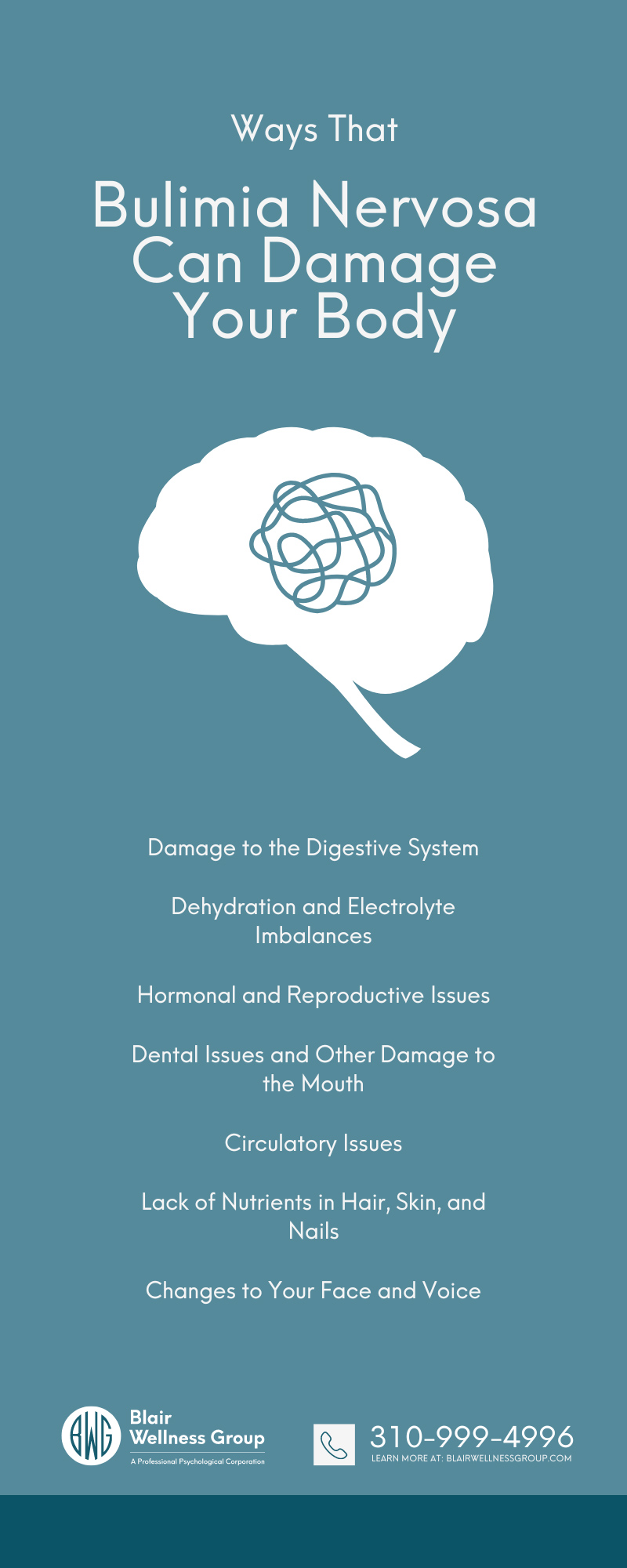
Ways That Bulimia Nervosa Can Damage Your Body

Licensed Clinical Psychologist & Performance Coach for C-Suite Executives & Professionals at  | Website |  + posts

Dr. Cassidy Blair is a renowned Licensed Clinical Psychologist and trusted Performance Coach who specializes in providing Concierge-Psychological Care and Executive Coaching for high-achieving professionals. With a deep understanding of the unique challenges faced by CEOs, executives, entrepreneurs, and leaders, Dr. Blair offers tailored, confidential care designed to foster emotional well-being, personal growth, and professional excellence. Her clientele values her discretion, clinical expertise, and emotionally intelligent approach to navigating complex personal and professional dynamics.

Related Blog

The Hidden Struggles of Men with Narcissistic Traits

High-achieving men in demanding professions often present themselves as confident, decisive, and successful. Yet beneath this exterior, many quietly grapple with challenges associated with Narcissistic Traits. Understanding these traits from a psychological perspective can help illuminate why they develop, how they manifest, and what impact they have on both professional success and personal well-being. Understanding

Is it Therapy or Performance Coaching You Need?

High-achieving professionals such as executives, entrepreneurs, attorneys, and physicians often face intense pressures that can lead to workaholism, anxiety, relationship conflicts, and perfectionism. If you are considering professional support, understanding the fundamental differences between therapy and Performance coaching is essential to making the right choice for your needs. What is Therapy? The Science Behind Psychological

Understanding Compulsive Sexual Behavior in Professional Men and Executives

Compulsive Sexual Behavior is a complex and often misunderstood condition that can significantly affect the lives of high-level professionals. For men in positions of power, such as CEOs, executives, entrepreneurs, attorneys, and physicians, this pattern of behavior can exist beneath a carefully maintained exterior of control, success, and discipline. The need for secrecy, combined with

Looking for a Local Psychologist?

Our Psychologists and Therapists in Los Angeles, Beverly Hills, Irvine, Newport Beach, and the surrounding areas offer evening and weekend appointments for our Concierge patients. Contact us today to discover how Blair Wellness Group can help you overcome personal or professional challenges and mental health disorders, such as depression, anxiety, relationship challenges, addiction issues, and personality disorders. 

Scroll to Top

Request An Appointment

var gform;gform||(document.addEventListener("gform_main_scripts_loaded",function(){gform.scriptsLoaded=!0}),document.addEventListener("gform/theme/scripts_loaded",function(){gform.themeScriptsLoaded=!0}),window.addEventListener("DOMContentLoaded",function(){gform.domLoaded=!0}),gform={domLoaded:!1,scriptsLoaded:!1,themeScriptsLoaded:!1,isFormEditor:()=>"function"==typeof InitializeEditor,callIfLoaded:function(o){return!(!gform.domLoaded||!gform.scriptsLoaded||!gform.themeScriptsLoaded&&!gform.isFormEditor()||(gform.isFormEditor()&&console.warn("The use of gform.initializeOnLoaded() is deprecated in the form editor context and will be removed in Gravity Forms 3.1."),o(),0))},initializeOnLoaded:function(o){gform.callIfLoaded(o)||(document.addEventListener("gform_main_scripts_loaded",()=>{gform.scriptsLoaded=!0,gform.callIfLoaded(o)}),document.addEventListener("gform/theme/scripts_loaded",()=>{gform.themeScriptsLoaded=!0,gform.callIfLoaded(o)}),window.addEventListener("DOMContentLoaded",()=>{gform.domLoaded=!0,gform.callIfLoaded(o)}))},hooks:{action:{},filter:{}},addAction:function(o,r,e,t){gform.addHook("action",o,r,e,t)},addFilter:function(o,r,e,t){gform.addHook("filter",o,r,e,t)},doAction:function(o){gform.doHook("action",o,arguments)},applyFilters:function(o){return gform.doHook("filter",o,arguments)},removeAction:function(o,r){gform.removeHook("action",o,r)},removeFilter:function(o,r,e){gform.removeHook("filter",o,r,e)},addHook:function(o,r,e,t,n){null==gform.hooks[o][r]&&(gform.hooks[o][r]=[]);var d=gform.hooks[o][r];null==n&&(n=r+"_"+d.length),gform.hooks[o][r].push({tag:n,callable:e,priority:t=null==t?10:t})},doHook:function(r,o,e){var t;if(e=Array.prototype.slice.call(e,1),null!=gform.hooks[r][o]&&((o=gform.hooks[r][o]).sort(function(o,r){return o.priority-r.priority}),o.forEach(function(o){"function"!=typeof(t=o.callable)&&(t=window[t]),"action"==r?t.apply(null,e):e[0]=t.apply(null,e)})),"filter"==r)return e[0]},removeHook:function(o,r,t,n){var e;null!=gform.hooks[o][r]&&(e=(e=gform.hooks[o][r]).filter(function(o,r,e){return!!(null!=n&&n!=o.tag||null!=t&&t!=o.priority)}),gform.hooks[o][r]=e)}});

document.getElementById( "ak_js_1" ).setAttribute( "value", ( new Date() ).getTime() );
  • This field is for validation purposes and should be left unchanged.
  • MM slash DD slash YYYY
  • Cancellation/Refund Policy:

    Please note, there are absolutely no refunds for any of your prepaid sessions in case of broken appointments by you as the professional times and days were reserved for you and will be considered as broken appointments. We ask that you do not make appointments unless you fully intend to keep all your future weekly appointments as we do not issue refunds on ANY prepaid appointment. Please note, our practice is fully committed based on previously scheduled times for our clients at least 2 weeks in advance.
  • Clear Signature
gform.initializeOnLoaded( function() {gformInitSpinner( 4, 'https://blairwellnessgroup.com/wp-content/plugins/gravityforms/images/spinner.svg', true );jQuery('#gform_ajax_frame_4').on('load',function(){var contents = jQuery(this).contents().find('*').html();var is_postback = contents.indexOf('GF_AJAX_POSTBACK') >= 0;if(!is_postback){return;}var form_content = jQuery(this).contents().find('#gform_wrapper_4');var is_confirmation = jQuery(this).contents().find('#gform_confirmation_wrapper_4').length > 0;var is_redirect = contents.indexOf('gformRedirect(){') >= 0;var is_form = form_content.length > 0 && ! is_redirect && ! is_confirmation;var mt = parseInt(jQuery('html').css('margin-top'), 10) + parseInt(jQuery('body').css('margin-top'), 10) + 100;if(is_form){jQuery('#gform_wrapper_4').html(form_content.html());if(form_content.hasClass('gform_validation_error')){jQuery('#gform_wrapper_4').addClass('gform_validation_error');} else {jQuery('#gform_wrapper_4').removeClass('gform_validation_error');}setTimeout( function() { /* delay the scroll by 50 milliseconds to fix a bug in chrome */ jQuery(document).scrollTop(jQuery('#gform_wrapper_4').offset().top - mt); }, 50 );if(window['gformInitDatepicker']) {gformInitDatepicker();}if(window['gformInitPriceFields']) {gformInitPriceFields();}var current_page = jQuery('#gform_source_page_number_4').val();gformInitSpinner( 4, 'https://blairwellnessgroup.com/wp-content/plugins/gravityforms/images/spinner.svg', true );jQuery(document).trigger('gform_page_loaded', [4, current_page]);window['gf_submitting_4'] = false;}else if(!is_redirect){var confirmation_content = jQuery(this).contents().find('.GF_AJAX_POSTBACK').html();if(!confirmation_content){confirmation_content = contents;}jQuery('#gform_wrapper_4').replaceWith(confirmation_content);jQuery(document).scrollTop(jQuery('#gf_4').offset().top - mt);jQuery(document).trigger('gform_confirmation_loaded', [4]);window['gf_submitting_4'] = false;wp.a11y.speak(jQuery('#gform_confirmation_message_4').text());}else{jQuery('#gform_4').append(contents);if(window['gformRedirect']) {gformRedirect();}}jQuery(document).trigger("gform_pre_post_render", [{ formId: "4", currentPage: "current_page", abort: function() { this.preventDefault(); } }]); if (event && event.defaultPrevented) { return; } const gformWrapperDiv = document.getElementById( "gform_wrapper_4" ); if ( gformWrapperDiv ) { const visibilitySpan = document.createElement( "span" ); visibilitySpan.id = "gform_visibility_test_4"; gformWrapperDiv.insertAdjacentElement( "afterend", visibilitySpan ); } const visibilityTestDiv = document.getElementById( "gform_visibility_test_4" ); let postRenderFired = false; function triggerPostRender() { if ( postRenderFired ) { return; } postRenderFired = true; gform.core.triggerPostRenderEvents( 4, current_page ); if ( visibilityTestDiv ) { visibilityTestDiv.parentNode.removeChild( visibilityTestDiv ); } } function debounce( func, wait, immediate ) { var timeout; return function() { var context = this, args = arguments; var later = function() { timeout = null; if ( !immediate ) func.apply( context, args ); }; var callNow = immediate && !timeout; clearTimeout( timeout ); timeout = setTimeout( later, wait ); if ( callNow ) func.apply( context, args ); }; } const debouncedTriggerPostRender = debounce( function() { triggerPostRender(); }, 200 ); if ( visibilityTestDiv && visibilityTestDiv.offsetParent === null ) { const observer = new MutationObserver( ( mutations ) => { mutations.forEach( ( mutation ) => { if ( mutation.type === 'attributes' && visibilityTestDiv.offsetParent !== null ) { debouncedTriggerPostRender(); observer.disconnect(); } }); }); observer.observe( document.body, { attributes: true, childList: false, subtree: true, attributeFilter: [ 'style', 'class' ], }); } else { triggerPostRender(); } } );} );