
To Provide Quality Care and Protect Patient's Privacy, We Do Not Accept Insurance.

Concierge Psychology Exclusively Tailored for the Clinical Needs and Coaching Demands of Professional Men, Executives, Entrepreneurs, Attorneys, Physicians & Surgeons

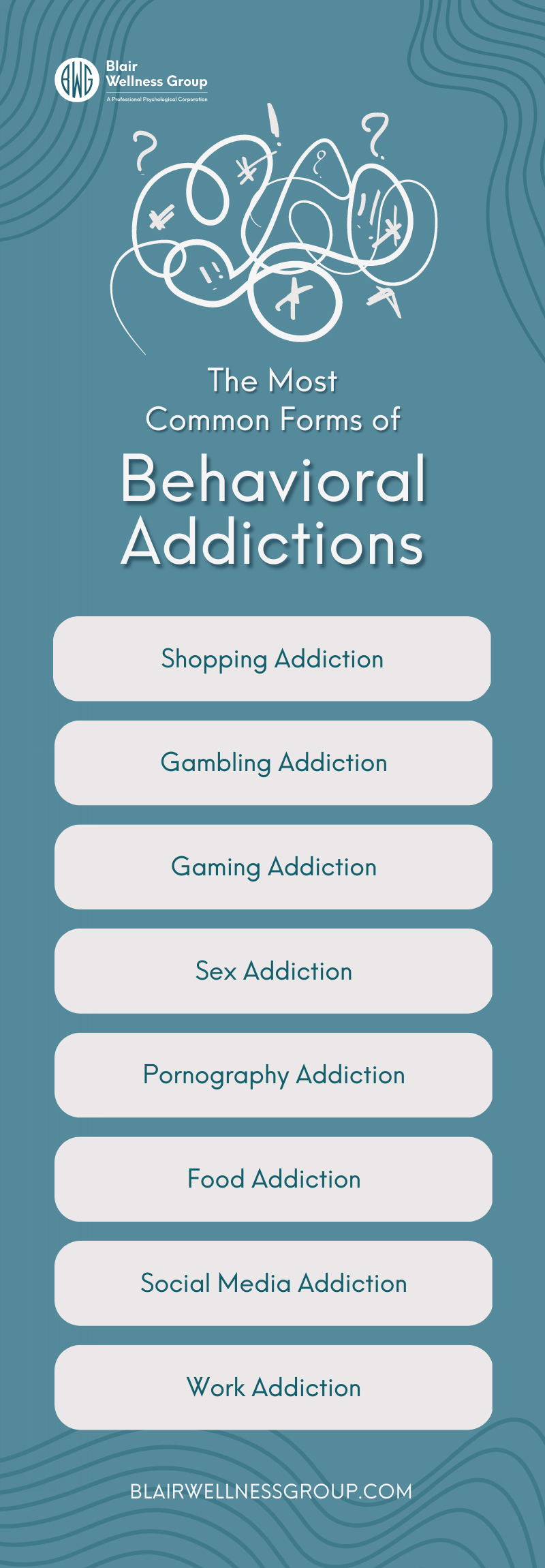
The Most Common Forms of Behavioral Addictions

When most people think of addiction, they think of Physical Addictions such as alcoholism or drug abuse. However, these are not the only kinds of addiction in today’s world. Though Behavioral Addictions are not as common or well-known as Substance Abuse Disorders, they are just as real and harmful. Unlike those with a dependency on drugs or alcohol, people suffering from Behavioral Addictions are compelled to engage in certain behaviors or activities obsessively, despite the negative and adverse consequences on their mental health, well-being, daily functioning, work obligations, or relationships. 

In this blog, we will explore the most common forms of Behavioral Addictions and delve deeper into their traits to help you recognize them and get the professional treatment you need.  

Signs and Symptoms of Behavioral Addiction 

The signs of a behavioral addiction can be subtle or even mistaken for a passionate hobby, making it difficult to identify and address them. Common symptoms include intense cravings, withdrawal symptoms like irritability or depression when not engaging in the behavior, interference in relationships or work, and chronic relapse even with intervention. Unlike individuals who are managing Alcohol Addiction or Drug and Substance Abuse, people with Behavioral Addiction may lack chemical dependency on a particular substance; however, they share similar patterns of obsessive-compulsive, self-destructive actions that impact all facets of their lives and daily functioning. 

Types of Behavioral Addictions 

There are several different types of Behavioral Addictions, each with its own unique causes, symptoms, and consequences. Keep in mind that many Behavioral Addictions stem from activities that could be normal or healthy in moderation. The key factor is that Behavioral Addiction turns ordinary enthusiasm into an obsessive preoccupation. Learn more about the most common forms of Behavioral Addictions and their effects below. 

Shopping Addiction 

One of the most prevalent Behavioral Addictions in today’s consumer-driven society is shopping addiction, also known as compulsive buying or oniomania. Individuals with this addiction find satisfaction in making purchases, even when those purchases come with consequences such as hoarding items that are not necessary and spending money on conspicuous consumption leading to financial debt and interpersonal conflict. Shopping addiction can also lead to feeling remorseful and low self-esteem, given the negative consequences in daily life and relationships. The constant search for the next “high” from a new purchase keeps the person trapped in a cycle of temporary gratification, followed by feelings of guilt and shame. 

Gambling Addiction 

Gambling addiction, or pathological gambling, is a serious Behavioral Addiction characterized by an uncontrollable urge to gamble and chase losses, regardless of the negative impact on the person’s life. While most people gamble for fun or entertainment, those with gambling addiction engage in risky bets and suffer emotional, financial, and interpersonal consequences. They continue to gamble even when it leads to severe personal problems, and their need to gamble consumes their thoughts, mind, emotions, and behaviors. 

Gaming Addiction 

Gaming addiction, also referred to as video game addiction or internet gaming disorder, is a Behavioral Addiction characterized by excessive, persistent, and uncontrolled engagement with video games to the point that it causes disruption to daily life commitments and functioning. Those with a gaming addiction prioritize gaming above all other aspects of their lives and responsibilities to work, relationships, and commitments, leading to detrimental consequences such as sleep disorders, poor academic or work performance, cheating, habitual lying, pathological manipulation, deceitful conduct, inability to function adaptively in life, and social awkwardness. 

Sex Addiction 

Sex addiction, also known as compulsive sexual behavior or hypersexuality, is an obsessive preoccupation with sexual thoughts, feelings, and actions that can lead to severe consequences on the individual’s mental, emotional, and physical health. Consequences of sex addiction include engaging in risky sexual behaviors, failing to maintain committed relationships, inability to sustain daily life responsibilities, social isolation, and using sex to escape from emotional distress, pain, rage, and internal feelings of shame and guilt. 

Pornography Addiction 

Pornography addiction is a form of sexual addiction characterized by compulsive, excessive engagement with sexually explicit content. Individuals with this addiction experience an inability to stop or control their consumption of pornography. This often leads to spending excessive time viewing explicit material, progressively seeking more novel or extreme content to achieve the same high, intimacy issues that negatively impact romantic relationships, and other consequences. Over time, those with porn addictions risk relationships, daily commitments, and work obligations to maintain their negative habits and addictions.  

Food Addiction 

Food addiction revolves around a compulsive desire to consume specific foods or engage in harmful eating behaviors despite the negative consequences doing so has on one’s mental health, physical health, and emotional well-being. Individuals with food addiction can experience a range of negative physical and mental health effects, including weight gain, diabetes, high blood pressure, high cholesterol, cardiac problems, nutritional deficiencies, digestive issues, lack of self-esteem, depression, and anxiety. Additionally, individuals with food addiction often find themselves obsessively craving the foods they are addicted to and may even be unable to control their consumption of unhealthy foods. Food addiction has become an increasingly concerning issue due to its negative impact on the individual’s physical health, mental health, and well-being. 

Social Media Addiction 

Social media addiction is a behavioral disorder characterized by an unhealthy dependence on the consumption of digital content through social media platforms, various websites, chat rooms, or the dark web. Individuals with social media addiction may find themselves caught in an endless cycle of browsing and consuming digital content, often to the deterioration of their mental health and the significant detriment to their physical health. People with social media addiction may struggle to regulate their time spent online to no avail. Social media addiction can also lead to a preoccupation with using social networks or difficulty controlling how much time you spend posting or engaging in activities related to social media. As more people are becoming reliant on technology, the impact of this form of addiction has grown drastically over the many years. 

Finding Professional Help for Addiction Disorders 

Behavioral Addictions severely impact physical and mental health, taking a toll on your overall quality of life. Professional treatment from a Licensed Clinical Psychologist can help you regain control of your addiction, improve your overall well-being, and build a healthier life for yourself. Contact Blair Wellness Group to meet with an addiction therapist in Orange County and start your journey to better health today. 
Licensed Clinical Psychologist & Performance Coach for C-Suite Executives & Professionals at  | Website |  + posts

Dr. Cassidy Blair is a renowned Licensed Clinical Psychologist and trusted Performance Coach who specializes in providing Concierge-Psychological Care and Executive Coaching for high-achieving professionals. With a deep understanding of the unique challenges faced by CEOs, executives, entrepreneurs, and leaders, Dr. Blair offers tailored, confidential care designed to foster emotional well-being, personal growth, and professional excellence. Her clientele values her discretion, clinical expertise, and emotionally intelligent approach to navigating complex personal and professional dynamics.


Related Blog

The Hidden Struggles of Men with Narcissistic Traits

High-achieving men in demanding professions often present themselves as confident, decisive, and successful. Yet beneath this exterior, many quietly grapple with challenges associated with Narcissistic Traits. Understanding these traits from a psychological perspective can help illuminate why they develop, how they manifest, and what impact they have on both professional success and personal well-being. Understanding

Is it Therapy or Performance Coaching You Need?

High-achieving professionals such as executives, entrepreneurs, attorneys, and physicians often face intense pressures that can lead to workaholism, anxiety, relationship conflicts, and perfectionism. If you are considering professional support, understanding the fundamental differences between therapy and Performance coaching is essential to making the right choice for your needs. What is Therapy? The Science Behind Psychological

Understanding Compulsive Sexual Behavior in Professional Men and Executives

Compulsive Sexual Behavior is a complex and often misunderstood condition that can significantly affect the lives of high-level professionals. For men in positions of power, such as CEOs, executives, entrepreneurs, attorneys, and physicians, this pattern of behavior can exist beneath a carefully maintained exterior of control, success, and discipline. The need for secrecy, combined with

Looking for a Local Psychologist?

Our Psychologists and Therapists in Los Angeles, Beverly Hills, Irvine, Newport Beach, and the surrounding areas offer evening and weekend appointments for our Concierge patients. Contact us today to discover how Blair Wellness Group can help you overcome personal or professional challenges and mental health disorders, such as depression, anxiety, relationship challenges, addiction issues, and personality disorders. 

Scroll to Top

Request An Appointment

var gform;gform||(document.addEventListener("gform_main_scripts_loaded",function(){gform.scriptsLoaded=!0}),document.addEventListener("gform/theme/scripts_loaded",function(){gform.themeScriptsLoaded=!0}),window.addEventListener("DOMContentLoaded",function(){gform.domLoaded=!0}),gform={domLoaded:!1,scriptsLoaded:!1,themeScriptsLoaded:!1,isFormEditor:()=>"function"==typeof InitializeEditor,callIfLoaded:function(o){return!(!gform.domLoaded||!gform.scriptsLoaded||!gform.themeScriptsLoaded&&!gform.isFormEditor()||(gform.isFormEditor()&&console.warn("The use of gform.initializeOnLoaded() is deprecated in the form editor context and will be removed in Gravity Forms 3.1."),o(),0))},initializeOnLoaded:function(o){gform.callIfLoaded(o)||(document.addEventListener("gform_main_scripts_loaded",()=>{gform.scriptsLoaded=!0,gform.callIfLoaded(o)}),document.addEventListener("gform/theme/scripts_loaded",()=>{gform.themeScriptsLoaded=!0,gform.callIfLoaded(o)}),window.addEventListener("DOMContentLoaded",()=>{gform.domLoaded=!0,gform.callIfLoaded(o)}))},hooks:{action:{},filter:{}},addAction:function(o,r,e,t){gform.addHook("action",o,r,e,t)},addFilter:function(o,r,e,t){gform.addHook("filter",o,r,e,t)},doAction:function(o){gform.doHook("action",o,arguments)},applyFilters:function(o){return gform.doHook("filter",o,arguments)},removeAction:function(o,r){gform.removeHook("action",o,r)},removeFilter:function(o,r,e){gform.removeHook("filter",o,r,e)},addHook:function(o,r,e,t,n){null==gform.hooks[o][r]&&(gform.hooks[o][r]=[]);var d=gform.hooks[o][r];null==n&&(n=r+"_"+d.length),gform.hooks[o][r].push({tag:n,callable:e,priority:t=null==t?10:t})},doHook:function(r,o,e){var t;if(e=Array.prototype.slice.call(e,1),null!=gform.hooks[r][o]&&((o=gform.hooks[r][o]).sort(function(o,r){return o.priority-r.priority}),o.forEach(function(o){"function"!=typeof(t=o.callable)&&(t=window[t]),"action"==r?t.apply(null,e):e[0]=t.apply(null,e)})),"filter"==r)return e[0]},removeHook:function(o,r,t,n){var e;null!=gform.hooks[o][r]&&(e=(e=gform.hooks[o][r]).filter(function(o,r,e){return!!(null!=n&&n!=o.tag||null!=t&&t!=o.priority)}),gform.hooks[o][r]=e)}});

document.getElementById( "ak_js_1" ).setAttribute( "value", ( new Date() ).getTime() );
  • This field is for validation purposes and should be left unchanged.
  • MM slash DD slash YYYY
  • Cancellation/Refund Policy:

    Please note, there are absolutely no refunds for any of your prepaid sessions in case of broken appointments by you as the professional times and days were reserved for you and will be considered as broken appointments. We ask that you do not make appointments unless you fully intend to keep all your future weekly appointments as we do not issue refunds on ANY prepaid appointment. Please note, our practice is fully committed based on previously scheduled times for our clients at least 2 weeks in advance.
  • Clear Signature
gform.initializeOnLoaded( function() {gformInitSpinner( 4, 'https://blairwellnessgroup.com/wp-content/plugins/gravityforms/images/spinner.svg', true );jQuery('#gform_ajax_frame_4').on('load',function(){var contents = jQuery(this).contents().find('*').html();var is_postback = contents.indexOf('GF_AJAX_POSTBACK') >= 0;if(!is_postback){return;}var form_content = jQuery(this).contents().find('#gform_wrapper_4');var is_confirmation = jQuery(this).contents().find('#gform_confirmation_wrapper_4').length > 0;var is_redirect = contents.indexOf('gformRedirect(){') >= 0;var is_form = form_content.length > 0 && ! is_redirect && ! is_confirmation;var mt = parseInt(jQuery('html').css('margin-top'), 10) + parseInt(jQuery('body').css('margin-top'), 10) + 100;if(is_form){jQuery('#gform_wrapper_4').html(form_content.html());if(form_content.hasClass('gform_validation_error')){jQuery('#gform_wrapper_4').addClass('gform_validation_error');} else {jQuery('#gform_wrapper_4').removeClass('gform_validation_error');}setTimeout( function() { /* delay the scroll by 50 milliseconds to fix a bug in chrome */ jQuery(document).scrollTop(jQuery('#gform_wrapper_4').offset().top - mt); }, 50 );if(window['gformInitDatepicker']) {gformInitDatepicker();}if(window['gformInitPriceFields']) {gformInitPriceFields();}var current_page = jQuery('#gform_source_page_number_4').val();gformInitSpinner( 4, 'https://blairwellnessgroup.com/wp-content/plugins/gravityforms/images/spinner.svg', true );jQuery(document).trigger('gform_page_loaded', [4, current_page]);window['gf_submitting_4'] = false;}else if(!is_redirect){var confirmation_content = jQuery(this).contents().find('.GF_AJAX_POSTBACK').html();if(!confirmation_content){confirmation_content = contents;}jQuery('#gform_wrapper_4').replaceWith(confirmation_content);jQuery(document).scrollTop(jQuery('#gf_4').offset().top - mt);jQuery(document).trigger('gform_confirmation_loaded', [4]);window['gf_submitting_4'] = false;wp.a11y.speak(jQuery('#gform_confirmation_message_4').text());}else{jQuery('#gform_4').append(contents);if(window['gformRedirect']) {gformRedirect();}}jQuery(document).trigger("gform_pre_post_render", [{ formId: "4", currentPage: "current_page", abort: function() { this.preventDefault(); } }]); if (event && event.defaultPrevented) { return; } const gformWrapperDiv = document.getElementById( "gform_wrapper_4" ); if ( gformWrapperDiv ) { const visibilitySpan = document.createElement( "span" ); visibilitySpan.id = "gform_visibility_test_4"; gformWrapperDiv.insertAdjacentElement( "afterend", visibilitySpan ); } const visibilityTestDiv = document.getElementById( "gform_visibility_test_4" ); let postRenderFired = false; function triggerPostRender() { if ( postRenderFired ) { return; } postRenderFired = true; gform.core.triggerPostRenderEvents( 4, current_page ); if ( visibilityTestDiv ) { visibilityTestDiv.parentNode.removeChild( visibilityTestDiv ); } } function debounce( func, wait, immediate ) { var timeout; return function() { var context = this, args = arguments; var later = function() { timeout = null; if ( !immediate ) func.apply( context, args ); }; var callNow = immediate && !timeout; clearTimeout( timeout ); timeout = setTimeout( later, wait ); if ( callNow ) func.apply( context, args ); }; } const debouncedTriggerPostRender = debounce( function() { triggerPostRender(); }, 200 ); if ( visibilityTestDiv && visibilityTestDiv.offsetParent === null ) { const observer = new MutationObserver( ( mutations ) => { mutations.forEach( ( mutation ) => { if ( mutation.type === 'attributes' && visibilityTestDiv.offsetParent !== null ) { debouncedTriggerPostRender(); observer.disconnect(); } }); }); observer.observe( document.body, { attributes: true, childList: false, subtree: true, attributeFilter: [ 'style', 'class' ], }); } else { triggerPostRender(); } } );} );