

To Provide Quality Care and Protect Patient's Privacy, We Do Not Accept Insurance.

Concierge Psychology Exclusively Tailored for the Clinical Needs and Coaching Demands of Professional Men, Executives, Entrepreneurs, Attorneys, Physicians & Surgeons

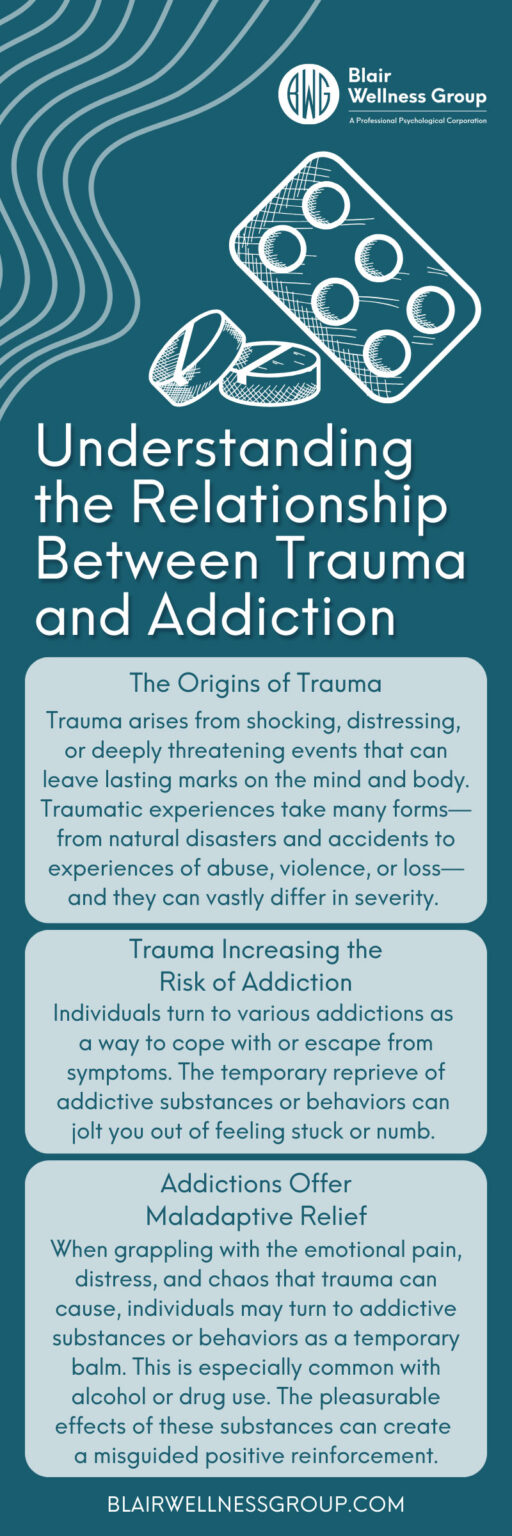
Understanding the Relationship Between Trauma and Addiction

Trauma and addiction are two complex and interconnected phenomena that occur in countless lives worldwide. Understanding their relationship is vital for anyone affected by either or both, as well as those who seek to support them. How does trauma affect individuals? How do those effects result in or exacerbate addictive behaviors? Learning more about the ways trauma and addiction intersect helps Licensed Clinical Psychologists and their clients find greater success when treating both disorders. Explore the relationship between trauma and addiction and see how proper treatment addresses both disorders with this overview. 

The Origins of Trauma 

Trauma arises from shocking, distressing, or deeply threatening events that can leave lasting marks on the mind and body. Traumatic experiences take many forms—from natural disasters and accidents to experiences of abuse, violence, or loss—and they can vastly differ in severity. Despite their wide-ranging nature, all forms of trauma share a common ability to disrupt our sense of safety, resilience, and self-efficacy. 

When faced with a traumatic event, the brain undergoes a physiological response that can have long-term consequences. The release of stress hormones such as cortisol and adrenaline, alongside a surge in sensory information, can alter the brain’s pathways. These hormones leave profound effects on memory, emotional regulation, and even your perception of time and space.  

Physical, Mental, and Emotional Symptoms of Trauma 

There is no one way to describe trauma and its symptoms. Everyone faces different challenges based on their circumstances and the type of trauma they face. Emotional symptoms might include numbness and depression or hypervigilance and anxiety. Someone might even feel angry or irritable because of their experience with trauma. 

There are also numerous physical symptoms of trauma. It can hinder digestive health and lead to the development of chronic pain. Headaches, muscle aches, and sleeping difficulties due to insomnia or nightmares are also common symptoms of trauma. 

Trauma Increasing the Risk of Addiction 

So, what is the link between trauma and addiction? Put simply, the lasting effects of trauma increase the risk of developing addictive behaviors. Symptoms such as depersonalization and numbness can make addictions like substance use, gambling, or food addictions more enticing.  

Individuals turn to various addictions as a way to cope with or escape from symptoms. The temporary reprieve of addictive substances or behaviors can jolt you out of feeling stuck or numb. Additionally, the short-term pleasure from the same addictions can provide relief from ongoing stress or pain that results from trauma. 

A Dysregulated Stress System 

One of the main ties that creates the relationship between trauma and addiction is the body’s stress system. Think of your stress system as a built-in security response; it is responsible for helping you react quickly and effectively to danger. When you are in a dangerous situation, an automatic stress response—such as fight or flight—can save your life.  

If that stress response is active when there is no immediate danger, though, it can create a dysregulated stress system. Chronic stress from prolonged or unresolved threats and trauma leads to hypervigilance, alertness, and anxiety.  

Over time, a dysregulated stress system affects executive functioning, cognitive development, physical health, and more. This is particularly true if someone experiences childhood trauma and dysregulation of the stress system during key developmental years. Ongoing trauma can hinder emotional regulation, create a negative attachment style, and contribute to mental and emotional challenges that increase the risk for Addiction Disorders and other Mental Health Conditions. 

Addictions Offer Maladaptive Relief 

When grappling with the emotional pain, distress, and chaos that trauma can cause, individuals may turn to addictive substances or behaviors as a temporary balm. This is especially common with alcohol or drug use. The pleasurable effects of these substances can create a misguided positive reinforcement. Moreover, alcohol and other depressants can offer relief from the hypervigilance and anxiety of a dysregulated stress system. 

Behavioral Addictions such as gambling or gaming can also create a sense of positive reinforcement that makes them more and more compelling as symptoms of trauma worsen. Furthermore, addictive behaviors can create an intense level of focus, which takes over the mind for a time and suppresses thoughts of stress or anxiety. As a result, addictive behavior distracts those with unprocessed trauma from the hurtful emotions, sensations, or memories they are seeking to escape. 

The Cycle of Trauma and Addiction 

The reprieve and distraction of Addiction Disorders are only temporary, though. Worse, these addictions create a negative cycle with trauma, exacerbating both disorders and making it harder for individuals to get the help they deserve. 

Individuals with trauma turn to addictive substances or behaviors for relief, but the reprieve is temporary. Meanwhile, they build a dependency, and their trauma symptoms worsen. This dependency leads to them craving the addiction more, which means the cycle continues. Meanwhile, the effects of Addiction Disorders—such as poor job performance, relationship strain, isolation, and the development of comorbid disorders like Anxiety or Depression—continue to worsen overall well-being. 

The Need for Comprehensive Treatment 

When trauma and addiction meet, you cannot just treat one part. Instead, you need a comprehensive treatment plan that addresses the unique relationship between your trauma and your addiction. By exploring the root of trauma, how it led to addiction, and how both affect all aspects of life, you can better understand every aspect of your mental health. This understanding, in turn, makes it easier to overcome those challenges. 

Mental Health Treatment With Blair Wellness Group 

At Blair Wellness Group, we work closely with clients to develop a tailored treatment plan that addresses the unique and complex challenges of trauma, addiction, and the relationship between the two. Dr. Blair has experience treating Trauma Disorders and Addiction Disorders with evidence-based therapies like Cognitive Behavioral Therapy (CBT), Eye Movement Desensitization and Reprocessing (EMDR), and more. 

By examining trauma and addiction as co-occurring Mental Health Disorders, Dr. Blair helps clients understand and overcome the cycle that these two conditions create. Heal from the effects and challenges of trauma when you turn to Blair Wellness Group for substance abuse therapy in Orange County and the surrounding areas. Make an appointment today and take this first crucial step on your journey toward better mental, emotional, and physical health. 
Licensed Clinical Psychologist & Performance Coach for C-Suite Executives & Professionals at  | Website |  + posts

Dr. Cassidy Blair is a renowned Licensed Clinical Psychologist and trusted Performance Coach who specializes in providing Concierge-Psychological Care and Executive Coaching for high-achieving professionals. With a deep understanding of the unique challenges faced by CEOs, executives, entrepreneurs, and leaders, Dr. Blair offers tailored, confidential care designed to foster emotional well-being, personal growth, and professional excellence. Her clientele values her discretion, clinical expertise, and emotionally intelligent approach to navigating complex personal and professional dynamics.

Related Blog

The Hidden Struggles of Men with Narcissistic Traits

High-achieving men in demanding professions often present themselves as confident, decisive, and successful. Yet beneath this exterior, many quietly grapple with challenges associated with Narcissistic Traits. Understanding these traits from a psychological perspective can help illuminate why they develop, how they manifest, and what impact they have on both professional success and personal well-being. Understanding

Is it Therapy or Performance Coaching You Need?

High-achieving professionals such as executives, entrepreneurs, attorneys, and physicians often face intense pressures that can lead to workaholism, anxiety, relationship conflicts, and perfectionism. If you are considering professional support, understanding the fundamental differences between therapy and Performance coaching is essential to making the right choice for your needs. What is Therapy? The Science Behind Psychological

Understanding Compulsive Sexual Behavior in Professional Men and Executives

Compulsive Sexual Behavior is a complex and often misunderstood condition that can significantly affect the lives of high-level professionals. For men in positions of power, such as CEOs, executives, entrepreneurs, attorneys, and physicians, this pattern of behavior can exist beneath a carefully maintained exterior of control, success, and discipline. The need for secrecy, combined with

Looking for a Local Psychologist?

Our Psychologists and Therapists in Los Angeles, Beverly Hills, Irvine, Newport Beach, and the surrounding areas offer evening and weekend appointments for our Concierge patients. Contact us today to discover how Blair Wellness Group can help you overcome personal or professional challenges and mental health disorders, such as depression, anxiety, relationship challenges, addiction issues, and personality disorders. 

Scroll to Top

Request An Appointment

var gform;gform||(document.addEventListener("gform_main_scripts_loaded",function(){gform.scriptsLoaded=!0}),document.addEventListener("gform/theme/scripts_loaded",function(){gform.themeScriptsLoaded=!0}),window.addEventListener("DOMContentLoaded",function(){gform.domLoaded=!0}),gform={domLoaded:!1,scriptsLoaded:!1,themeScriptsLoaded:!1,isFormEditor:()=>"function"==typeof InitializeEditor,callIfLoaded:function(o){return!(!gform.domLoaded||!gform.scriptsLoaded||!gform.themeScriptsLoaded&&!gform.isFormEditor()||(gform.isFormEditor()&&console.warn("The use of gform.initializeOnLoaded() is deprecated in the form editor context and will be removed in Gravity Forms 3.1."),o(),0))},initializeOnLoaded:function(o){gform.callIfLoaded(o)||(document.addEventListener("gform_main_scripts_loaded",()=>{gform.scriptsLoaded=!0,gform.callIfLoaded(o)}),document.addEventListener("gform/theme/scripts_loaded",()=>{gform.themeScriptsLoaded=!0,gform.callIfLoaded(o)}),window.addEventListener("DOMContentLoaded",()=>{gform.domLoaded=!0,gform.callIfLoaded(o)}))},hooks:{action:{},filter:{}},addAction:function(o,r,e,t){gform.addHook("action",o,r,e,t)},addFilter:function(o,r,e,t){gform.addHook("filter",o,r,e,t)},doAction:function(o){gform.doHook("action",o,arguments)},applyFilters:function(o){return gform.doHook("filter",o,arguments)},removeAction:function(o,r){gform.removeHook("action",o,r)},removeFilter:function(o,r,e){gform.removeHook("filter",o,r,e)},addHook:function(o,r,e,t,n){null==gform.hooks[o][r]&&(gform.hooks[o][r]=[]);var d=gform.hooks[o][r];null==n&&(n=r+"_"+d.length),gform.hooks[o][r].push({tag:n,callable:e,priority:t=null==t?10:t})},doHook:function(r,o,e){var t;if(e=Array.prototype.slice.call(e,1),null!=gform.hooks[r][o]&&((o=gform.hooks[r][o]).sort(function(o,r){return o.priority-r.priority}),o.forEach(function(o){"function"!=typeof(t=o.callable)&&(t=window[t]),"action"==r?t.apply(null,e):e[0]=t.apply(null,e)})),"filter"==r)return e[0]},removeHook:function(o,r,t,n){var e;null!=gform.hooks[o][r]&&(e=(e=gform.hooks[o][r]).filter(function(o,r,e){return!!(null!=n&&n!=o.tag||null!=t&&t!=o.priority)}),gform.hooks[o][r]=e)}});

document.getElementById( "ak_js_1" ).setAttribute( "value", ( new Date() ).getTime() );
  • This field is for validation purposes and should be left unchanged.
  • MM slash DD slash YYYY
  • Cancellation/Refund Policy:

    Please note, there are absolutely no refunds for any of your prepaid sessions in case of broken appointments by you as the professional times and days were reserved for you and will be considered as broken appointments. We ask that you do not make appointments unless you fully intend to keep all your future weekly appointments as we do not issue refunds on ANY prepaid appointment. Please note, our practice is fully committed based on previously scheduled times for our clients at least 2 weeks in advance.
  • Clear Signature
gform.initializeOnLoaded( function() {gformInitSpinner( 4, 'https://blairwellnessgroup.com/wp-content/plugins/gravityforms/images/spinner.svg', true );jQuery('#gform_ajax_frame_4').on('load',function(){var contents = jQuery(this).contents().find('*').html();var is_postback = contents.indexOf('GF_AJAX_POSTBACK') >= 0;if(!is_postback){return;}var form_content = jQuery(this).contents().find('#gform_wrapper_4');var is_confirmation = jQuery(this).contents().find('#gform_confirmation_wrapper_4').length > 0;var is_redirect = contents.indexOf('gformRedirect(){') >= 0;var is_form = form_content.length > 0 && ! is_redirect && ! is_confirmation;var mt = parseInt(jQuery('html').css('margin-top'), 10) + parseInt(jQuery('body').css('margin-top'), 10) + 100;if(is_form){jQuery('#gform_wrapper_4').html(form_content.html());if(form_content.hasClass('gform_validation_error')){jQuery('#gform_wrapper_4').addClass('gform_validation_error');} else {jQuery('#gform_wrapper_4').removeClass('gform_validation_error');}setTimeout( function() { /* delay the scroll by 50 milliseconds to fix a bug in chrome */ jQuery(document).scrollTop(jQuery('#gform_wrapper_4').offset().top - mt); }, 50 );if(window['gformInitDatepicker']) {gformInitDatepicker();}if(window['gformInitPriceFields']) {gformInitPriceFields();}var current_page = jQuery('#gform_source_page_number_4').val();gformInitSpinner( 4, 'https://blairwellnessgroup.com/wp-content/plugins/gravityforms/images/spinner.svg', true );jQuery(document).trigger('gform_page_loaded', [4, current_page]);window['gf_submitting_4'] = false;}else if(!is_redirect){var confirmation_content = jQuery(this).contents().find('.GF_AJAX_POSTBACK').html();if(!confirmation_content){confirmation_content = contents;}jQuery('#gform_wrapper_4').replaceWith(confirmation_content);jQuery(document).scrollTop(jQuery('#gf_4').offset().top - mt);jQuery(document).trigger('gform_confirmation_loaded', [4]);window['gf_submitting_4'] = false;wp.a11y.speak(jQuery('#gform_confirmation_message_4').text());}else{jQuery('#gform_4').append(contents);if(window['gformRedirect']) {gformRedirect();}}jQuery(document).trigger("gform_pre_post_render", [{ formId: "4", currentPage: "current_page", abort: function() { this.preventDefault(); } }]); if (event && event.defaultPrevented) { return; } const gformWrapperDiv = document.getElementById( "gform_wrapper_4" ); if ( gformWrapperDiv ) { const visibilitySpan = document.createElement( "span" ); visibilitySpan.id = "gform_visibility_test_4"; gformWrapperDiv.insertAdjacentElement( "afterend", visibilitySpan ); } const visibilityTestDiv = document.getElementById( "gform_visibility_test_4" ); let postRenderFired = false; function triggerPostRender() { if ( postRenderFired ) { return; } postRenderFired = true; gform.core.triggerPostRenderEvents( 4, current_page ); if ( visibilityTestDiv ) { visibilityTestDiv.parentNode.removeChild( visibilityTestDiv ); } } function debounce( func, wait, immediate ) { var timeout; return function() { var context = this, args = arguments; var later = function() { timeout = null; if ( !immediate ) func.apply( context, args ); }; var callNow = immediate && !timeout; clearTimeout( timeout ); timeout = setTimeout( later, wait ); if ( callNow ) func.apply( context, args ); }; } const debouncedTriggerPostRender = debounce( function() { triggerPostRender(); }, 200 ); if ( visibilityTestDiv && visibilityTestDiv.offsetParent === null ) { const observer = new MutationObserver( ( mutations ) => { mutations.forEach( ( mutation ) => { if ( mutation.type === 'attributes' && visibilityTestDiv.offsetParent !== null ) { debouncedTriggerPostRender(); observer.disconnect(); } }); }); observer.observe( document.body, { attributes: true, childList: false, subtree: true, attributeFilter: [ 'style', 'class' ], }); } else { triggerPostRender(); } } );} );