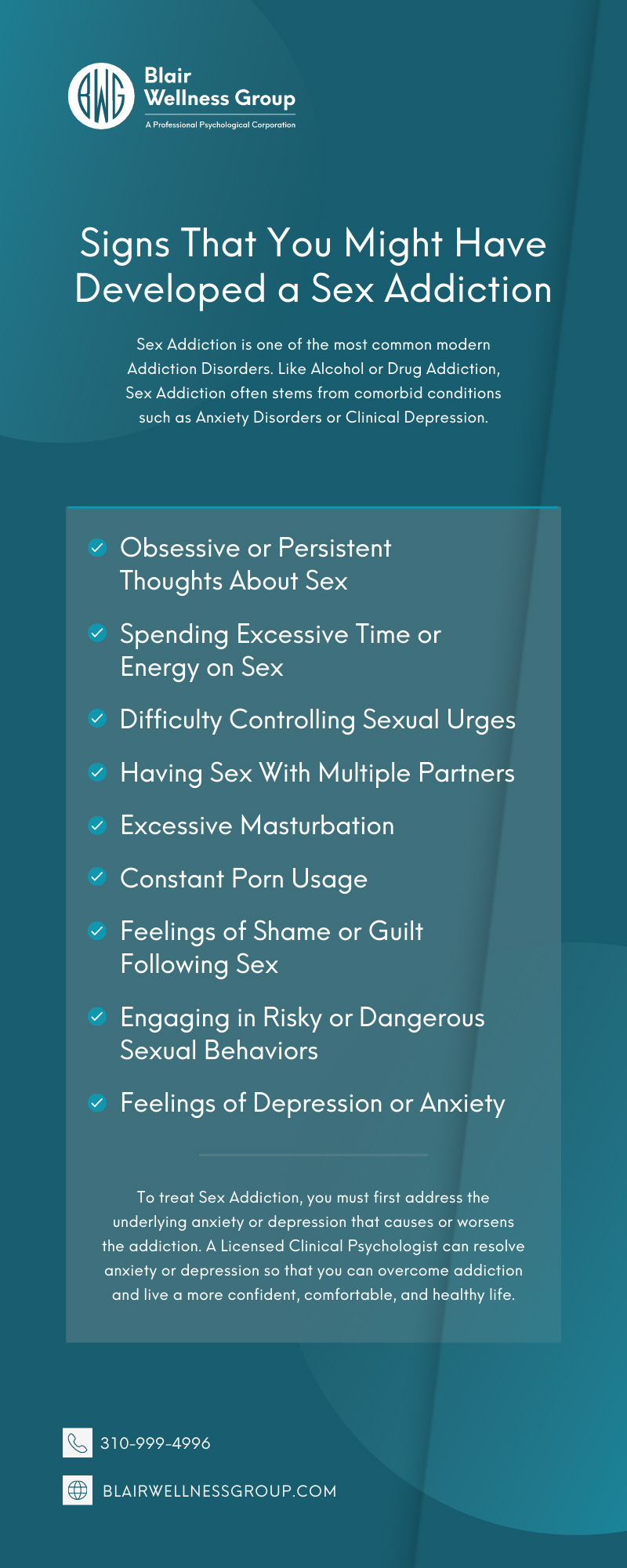
Sex Addiction is one of the most common modern Addiction Disorders. Like Alcohol or Drug Addiction, Sex Addiction often stems from comorbid conditions such as Anxiety Disorders or Clinical Depression. Sex Addiction is also disruptive and dangerous and can negatively affect your personal, professional, and social life if left untreated.
The taboo around Sex Addiction—and sex in general—makes it difficult to talk about this type of Addiction Disorder. However, understanding what Sex Addiction and how it affects your life is the key to recognizing your problem and finding the help you need from a Licensed Clinical Psychologist. Read on to learn more about the signs that you might have developed a Sex Addiction and see how a Licensed Clinical Psychologist can help you set and achieve measurable, realistic treatment goals.
An Introduction to Sex Addiction
Sex Addiction is an Addiction Disorder wherein an individual struggles to control their thoughts, feelings, and behaviors regarding sex. While sex itself is a natural and healthy part of life, Sex Addiction involves compulsive sexual thoughts and behaviors that are detrimental to your life.
Sex Addiction presents itself in many different ways. While addiction to sexual acts is common, you might also experience additional forms of sexual addiction, including:
Pornography
Masturbation
Sexual fantasies
Prostitution
Exhibition or voyeurism
Sadistic or masochistic sexual behaviors
Just as substance abuse can disrupt and harm your physical and mental health, Sex Addiction can damage your physical and mental health, professional life, romantic relationships, and overall quality of life.
Signs of a Sex Addiction
Only a Licensed Clinical Psychologist can diagnose you with a Sex Addiction. That’s why it’s important to consult with a Psychologist if you’re experiencing compulsive sexual thoughts and behaviors or feelings of anxiety or depression.
However, there are a few signs and symptoms of a Sex Addiction that you can watch out for in your day-to-day life. If you’re experiencing these thoughts or behaviors, be sure to seek professional treatment from a Licensed Clinical Psychologist.
Obsessive or Persistent Thoughts About Sex
Obsessive sexual thoughts and fantasies are one of the most common signs of Sex Addiction. Chronic or persistent thoughts about sex can turn into obsessive behavior that interferes with other aspects of life. Obsession over sexual thoughts or fantasies can disrupt your daily routines, distract you at work, and even create tension in romantic relationships. Furthermore, persistently obsessive thoughts about sex can lead to compulsive sexual acts and other behaviors associated with Sex Addiction.
Spending Excessive Time or Energy on Sex
Just as sexual thoughts can disrupt your work, relationships, and daily routines, so can sexual acts. Sex Addiction can draw your focus away from responsibilities, hobbies, and relationships until you’re spending a majority of your time and energy on sexual acts. This might include spending time seeking out sex, performing sexual acts, or recovering from sexual behaviors.
Spending an excessive amount of time on sex also puts your physical and mental health in danger. As you put more energy toward satisfying your compulsive urges, your sexual boundaries can erode until you’re seeking out acts and situations that put yourself and others in danger.
Difficulty Controlling Sexual Urges
As with other Addiction Disorders, Sex Addiction causes your sexual thoughts and behaviors to become stronger over time. This makes it more difficult to control your sexual urges as time goes on. If you suffer from Sex Addiction, you’ll find it hard to reduce the time you spend thinking about or engaging in sexual acts. This creates an unhealthy cycle of addiction that requires treatment from a Licensed Clinical Psychologist.
Having Sex With Multiple Partners
The inability to control sexual urges—combined with a growing desire for sex—leads many individuals with Sex Addiction to engage with multiple sexual partners. In some cases, this leads to cheating on long-term partners or spouses. Having sex with multiple partners also increases your risk of contracting a sexually transmitted disease.
Excessive Masturbation
Like many sexual behaviors, masturbation can be a natural and healthy behavior in moderation. However, Sex Addiction can lead to excessive or compulsive masturbation that has negative consequences in your life.
Sex Addiction and addiction to masturbation can lead to engaging in masturbation multiple times a day or at inappropriate times or locations.
Constant Porn Usage
People living with Sex Addiction often use pornography as an outlet to relieve sexual desires or fantasies. However, porn is an ineffective and unhealthy coping mechanism that exacerbates the problem over time. Constant porn usage feeds into your Sex Addiction, worsening the issue and causing compulsive sexual thoughts or behaviors to grow.
Moreover, pornographic scenarios can create unrealistic expectations that make it hard to find pleasure in healthy, real-life sexual situations. As a result, some sex addicts—particularly men—experience erectile dysfunction and loss of function or pleasure during sex.
Feelings of Shame or Guilt Following Sex
While sex addicts might enjoy sexual acts in the moment, feelings of guilt or remorse often follow the experience. When healthy sexual behaviors turn into Sex Addiction, you might experience feelings of shame or regret about your sexual urges or experiences. You might also feel guilty about your lack of control over your compulsive sexual thoughts and behaviors.
Engaging in Risky or Dangerous Sexual Behaviors
Worsening compulsive sexual thoughts and urges can lead to sexual acts that are dangerous or inappropriate for yourself or those around you. Examples of risky or dangerous sexual behaviors that can stem from Sex Addiction include exhibition, voyeurism, unprotected sex, or even acts of sexual violence.
Feelings of Depression or Anxiety
Like many Addiction Disorders, Sex Addiction often stems from depression or anxiety. Some individuals can even develop a Sex Addiction after using sexual fantasies or behaviors to find short-term (but ultimately harmful) relief from Clinical Depression or an Anxiety Disorder.
Getting Help for Your Sex Addiction
To treat Sex Addiction, you must first address the underlying anxiety or depression that causes or worsens the addiction. A Licensed Clinical Psychologist can resolve anxiety or depression so that you can overcome addiction and live a more confident, comfortable, and healthy life.
Dr. Cassidy Blair is an experienced addiction psychologist in Los Angeles, Beverly Hills, Bel Air, Century City, Brentwood, Westwood, Irvine, Newport, Orange County, Huntington Beach, Laguna Beach, Corona Del Mar, Dana Point, Mission Viejo, and Aliso Viejo. She has the training and experience to provide a personalized treatment plan using a combination of evidence-based treatment modalities such as Cognitive Behavioral Treatment and Dialectical Behavioral Treatment. With professional treatment that focuses on the root of your Sex Addiction, you can regain control of your life, achieve your treatment goals, and lead a healthier and more fulfilling life.
We use cookies on our website to give you the most relevant experience by remembering your preferences and repeat visits. By clicking “Accept”, you consent to the use of ALL the cookies.
This website uses cookies to improve your experience while you navigate through the website. Out of these, the cookies that are categorized as necessary are stored on your browser as they are essential for the working of basic functionalities of the website. We also use third-party cookies that help us analyze and understand how you use this website. These cookies will be stored in your browser only with your consent. You also have the option to opt-out of these cookies. But opting out of some of these cookies may affect your browsing experience.
Necessary cookies are absolutely essential for the website to function properly. These cookies ensure basic functionalities and security features of the website, anonymously.
Cookie
Duration
Description
cookielawinfo-checbox-analytics
11 months
This cookie is set by GDPR Cookie Consent plugin. The cookie is used to store the user consent for the cookies in the category "Analytics".
cookielawinfo-checbox-functional
11 months
The cookie is set by GDPR cookie consent to record the user consent for the cookies in the category "Functional".
cookielawinfo-checbox-others
11 months
This cookie is set by GDPR Cookie Consent plugin. The cookie is used to store the user consent for the cookies in the category "Other.
cookielawinfo-checkbox-necessary
11 months
This cookie is set by GDPR Cookie Consent plugin. The cookies is used to store the user consent for the cookies in the category "Necessary".
cookielawinfo-checkbox-performance
11 months
This cookie is set by GDPR Cookie Consent plugin. The cookie is used to store the user consent for the cookies in the category "Performance".
viewed_cookie_policy
11 months
The cookie is set by the GDPR Cookie Consent plugin and is used to store whether or not user has consented to the use of cookies. It does not store any personal data.
Functional cookies help to perform certain functionalities like sharing the content of the website on social media platforms, collect feedbacks, and other third-party features.
Performance cookies are used to understand and analyze the key performance indexes of the website which helps in delivering a better user experience for the visitors.
Analytical cookies are used to understand how visitors interact with the website. These cookies help provide information on metrics the number of visitors, bounce rate, traffic source, etc.
Advertisement cookies are used to provide visitors with relevant ads and marketing campaigns. These cookies track visitors across websites and collect information to provide customized ads.