

To Provide Quality Care and Protect Patient's Privacy, We Do Not Accept Insurance.

Concierge Psychology Exclusively Tailored for the Clinical Needs and Coaching Demands of Professional Men, Executives, Entrepreneurs, Attorneys, Physicians & Surgeons

Substance Abuse vs. Addiction: What Is the Difference?

When people talk about the use of illicit substances, they often use the terms substance abuse and addiction interchangeably. These issues closely relate to each other, and both have a detrimental effect on your health, relationships, and career. However, they are not the same thing.  

Understanding the distinction between substance abuse and addiction allows you to address these problems clearly and effectively. Learn the difference between substance abuse and addiction and see how you can find treatment for these issues in your life with this overview. 

Substance Abuse Is an Action 

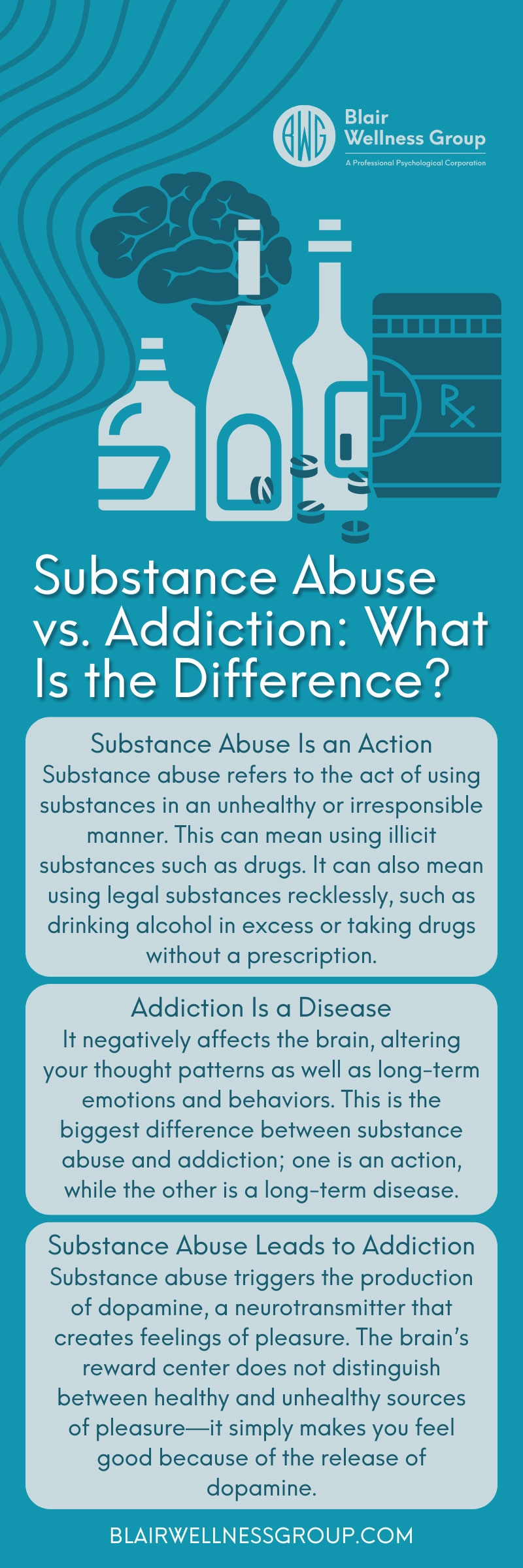
Substance abuse refers to the act of using substances in an unhealthy or irresponsible manner. This can mean using illicit substances such as drugs. It can also mean using legal substances recklessly, such as drinking alcohol in excess or taking drugs without a prescription.  

People partake in substance abuse for many reasons. Some might be trying to numb emotional pain or find release from stress and other negative emotions in their lives. Others might simply be taking a recreational activity too far. In many cases, substance abuse does not appear to be a problem at first. For example, it can be hard to tell the difference between someone who regularly drinks with friends and someone who relies on alcohol to maintain their social life. 

No matter what, substance abuse is a dangerous activity that has a lasting negative impact on your life. 

Addiction Is a Disease 

Substance Addictions—such as Drug Addiction or Alcohol Addiction—is a Mental Health Disorder. It negatively affects the brain, altering your thought patterns as well as long-term emotions and behaviors. This is the biggest difference between substance abuse and addiction; one is an action, while the other is a long-term disease. 

Addiction Disorders influence the neural pathways of your brain. This alters the performance of various neurotransmitters, interrupting cognitive processes and causing problems with the parts of the brain that are responsible for memory and learning. Over time, Addiction Disorders also weaken focus, motivation, and rational decision-making. 

These negative effects are what make addiction so dangerous. They also make it hard to overcome cravings and heal from your Addiction Disorder. 

Substance Abuse Leads to Addiction 

One of the reasons people often talk about substance abuse and addiction as if they are interchangeable is because the two issues have a cyclical relationship. While substance abuse is simply an action, the repetition of this behavior is what leads to an Addiction Disorder. Using drugs or misusing alcohol one time might not have much of a lasting impact. Over time, though, this repeated behavior begins to affect your brain’s reward center. 

Substance abuse triggers the production of dopamine, a neurotransmitter that creates feelings of pleasure. The brain’s reward center does not distinguish between healthy and unhealthy sources of pleasure—it simply makes you feel good because of the release of dopamine.  

Healthy sources of dopamine, such as exercise, often take time and effort to achieve, but substance abuse is instant and powerful. This is what makes it so addictive; your brain and your body come to rely on the release of dopamine you get from substance abuse, leading to the development of an Addiction Disorder. 

Addiction Worsens Substance Abuse 

At the same time, Addiction Disorders—and other Mental Health Disorders—increase the desire for maladaptive coping techniques such as substance abuse. As problems arise in your life, you are more likely to turn to substance abuse to feel pleasure, numb the pain, or drown out the negative thoughts and emotions that come with your Mental Health Disorder. 

Unfortunately, this is only a short-term, band aid approach. Each time you participate in substance abuse, you become more reliant on the substance and worsen your Addiction Disorder. Eventually, you will develop tolerance for the addictive behavior and require more engagement and consumption. Meanwhile, the mental, emotional, and physical symptoms of substance abuse and addiction continue to worsen, creating more severe consequences throughout your life. 

Both Affect the Rest of Your Life 

Both substance abuse and Addiction Disorders negatively affect your life, including your personal relationships, your romantic partnerships, your professional reputation, your physical and mental health. The longer these issues go on, the more severe and dangerous these consequences become. 

Impact on Your Relationships 

Substance abuse and Addiction Disorders put strain on relationships and make it hard to maintain strong, healthy connections with others. Issues such as poor communication, guilt, blame, and aggression can stem from substance abuse or addiction and create problems in your relationships.  

The negative emotions, behaviors, and thought patterns of addiction make it difficult to maintain an honest and trustworthy relationship. Furthermore, substance abuse and addiction make it difficult to manage responsibilities and hold yourself accountable, which can create unhealthy dynamics between you and your partner. 

Impact on Your Professional Life 

Substance abuse and addiction also affect your professional life. The consequences to your physical health can hinder your performance on the job and hold you back from certain opportunities in your career.  

Furthermore, poor focus and decision-making skills negatively harm your performance and prevent you from reaching your full potential at work. Other problems such as absenteeism, tardiness, and a negative professional reputation can also lead to consequences at work that have a serious impact on your entire career. 

Impact on Your Physical Health 

Drugs, alcohol, and other substances also impact your physical health. The physical effects of substance abuse and addiction vary depending on the type of substances you use, but common issues include an increased risk of cardiovascular disease, cancer, and lung disease. The use of drugs or alcohol can also put you in dangerous situations, such as driving a car while inebriated.  

Finding Your Way Out 

Substance abuse and Addiction Disorders can create an unhealthy downward spiral in your life. However, that does not mean it is impossible to find your way out. A Licensed Clinical Psychologist can help you navigate the symptoms and challenges of substance abuse and addiction so that you can rebuild your life and find peace and healing.  

If you are looking for an Addiction Psychologist in Los Angeles, Irvine, Beverly Hills, Newport Beach, Bel Air, Century City, Brentwood, Westwood, Huntington Beach, Mission Viejo, Aliso Viejo, and the surrounding areas, contact Blair Wellness Group to see how our evidence-based treatment plans can help you. 
Licensed Clinical Psychologist & Performance Coach for C-Suite Executives & Professionals at  | Website |  + posts

Dr. Cassidy Blair is a renowned Licensed Clinical Psychologist and trusted Performance Coach who specializes in providing Concierge-Psychological Care and Executive Coaching for high-achieving professionals. With a deep understanding of the unique challenges faced by CEOs, executives, entrepreneurs, and leaders, Dr. Blair offers tailored, confidential care designed to foster emotional well-being, personal growth, and professional excellence. Her clientele values her discretion, clinical expertise, and emotionally intelligent approach to navigating complex personal and professional dynamics.

Related Blog

The Hidden Struggles of Men with Narcissistic Traits

High-achieving men in demanding professions often present themselves as confident, decisive, and successful. Yet beneath this exterior, many quietly grapple with challenges associated with Narcissistic Traits. Understanding these traits from a psychological perspective can help illuminate why they develop, how they manifest, and what impact they have on both professional success and personal well-being. Understanding

Is it Therapy or Performance Coaching You Need?

High-achieving professionals such as executives, entrepreneurs, attorneys, and physicians often face intense pressures that can lead to workaholism, anxiety, relationship conflicts, and perfectionism. If you are considering professional support, understanding the fundamental differences between therapy and Performance coaching is essential to making the right choice for your needs. What is Therapy? The Science Behind Psychological

Understanding Compulsive Sexual Behavior in Professional Men and Executives

Compulsive Sexual Behavior is a complex and often misunderstood condition that can significantly affect the lives of high-level professionals. For men in positions of power, such as CEOs, executives, entrepreneurs, attorneys, and physicians, this pattern of behavior can exist beneath a carefully maintained exterior of control, success, and discipline. The need for secrecy, combined with

Looking for a Local Psychologist?

Our Psychologists and Therapists in Los Angeles, Beverly Hills, Irvine, Newport Beach, and the surrounding areas offer evening and weekend appointments for our Concierge patients. Contact us today to discover how Blair Wellness Group can help you overcome personal or professional challenges and mental health disorders, such as depression, anxiety, relationship challenges, addiction issues, and personality disorders. 

Scroll to Top

Request An Appointment

var gform;gform||(document.addEventListener("gform_main_scripts_loaded",function(){gform.scriptsLoaded=!0}),document.addEventListener("gform/theme/scripts_loaded",function(){gform.themeScriptsLoaded=!0}),window.addEventListener("DOMContentLoaded",function(){gform.domLoaded=!0}),gform={domLoaded:!1,scriptsLoaded:!1,themeScriptsLoaded:!1,isFormEditor:()=>"function"==typeof InitializeEditor,callIfLoaded:function(o){return!(!gform.domLoaded||!gform.scriptsLoaded||!gform.themeScriptsLoaded&&!gform.isFormEditor()||(gform.isFormEditor()&&console.warn("The use of gform.initializeOnLoaded() is deprecated in the form editor context and will be removed in Gravity Forms 3.1."),o(),0))},initializeOnLoaded:function(o){gform.callIfLoaded(o)||(document.addEventListener("gform_main_scripts_loaded",()=>{gform.scriptsLoaded=!0,gform.callIfLoaded(o)}),document.addEventListener("gform/theme/scripts_loaded",()=>{gform.themeScriptsLoaded=!0,gform.callIfLoaded(o)}),window.addEventListener("DOMContentLoaded",()=>{gform.domLoaded=!0,gform.callIfLoaded(o)}))},hooks:{action:{},filter:{}},addAction:function(o,r,e,t){gform.addHook("action",o,r,e,t)},addFilter:function(o,r,e,t){gform.addHook("filter",o,r,e,t)},doAction:function(o){gform.doHook("action",o,arguments)},applyFilters:function(o){return gform.doHook("filter",o,arguments)},removeAction:function(o,r){gform.removeHook("action",o,r)},removeFilter:function(o,r,e){gform.removeHook("filter",o,r,e)},addHook:function(o,r,e,t,n){null==gform.hooks[o][r]&&(gform.hooks[o][r]=[]);var d=gform.hooks[o][r];null==n&&(n=r+"_"+d.length),gform.hooks[o][r].push({tag:n,callable:e,priority:t=null==t?10:t})},doHook:function(r,o,e){var t;if(e=Array.prototype.slice.call(e,1),null!=gform.hooks[r][o]&&((o=gform.hooks[r][o]).sort(function(o,r){return o.priority-r.priority}),o.forEach(function(o){"function"!=typeof(t=o.callable)&&(t=window[t]),"action"==r?t.apply(null,e):e[0]=t.apply(null,e)})),"filter"==r)return e[0]},removeHook:function(o,r,t,n){var e;null!=gform.hooks[o][r]&&(e=(e=gform.hooks[o][r]).filter(function(o,r,e){return!!(null!=n&&n!=o.tag||null!=t&&t!=o.priority)}),gform.hooks[o][r]=e)}});

document.getElementById( "ak_js_1" ).setAttribute( "value", ( new Date() ).getTime() );
  • This field is for validation purposes and should be left unchanged.
  • MM slash DD slash YYYY
  • Cancellation/Refund Policy:

    Please note, there are absolutely no refunds for any of your prepaid sessions in case of broken appointments by you as the professional times and days were reserved for you and will be considered as broken appointments. We ask that you do not make appointments unless you fully intend to keep all your future weekly appointments as we do not issue refunds on ANY prepaid appointment. Please note, our practice is fully committed based on previously scheduled times for our clients at least 2 weeks in advance.
  • Clear Signature
gform.initializeOnLoaded( function() {gformInitSpinner( 4, 'https://blairwellnessgroup.com/wp-content/plugins/gravityforms/images/spinner.svg', true );jQuery('#gform_ajax_frame_4').on('load',function(){var contents = jQuery(this).contents().find('*').html();var is_postback = contents.indexOf('GF_AJAX_POSTBACK') >= 0;if(!is_postback){return;}var form_content = jQuery(this).contents().find('#gform_wrapper_4');var is_confirmation = jQuery(this).contents().find('#gform_confirmation_wrapper_4').length > 0;var is_redirect = contents.indexOf('gformRedirect(){') >= 0;var is_form = form_content.length > 0 && ! is_redirect && ! is_confirmation;var mt = parseInt(jQuery('html').css('margin-top'), 10) + parseInt(jQuery('body').css('margin-top'), 10) + 100;if(is_form){jQuery('#gform_wrapper_4').html(form_content.html());if(form_content.hasClass('gform_validation_error')){jQuery('#gform_wrapper_4').addClass('gform_validation_error');} else {jQuery('#gform_wrapper_4').removeClass('gform_validation_error');}setTimeout( function() { /* delay the scroll by 50 milliseconds to fix a bug in chrome */ jQuery(document).scrollTop(jQuery('#gform_wrapper_4').offset().top - mt); }, 50 );if(window['gformInitDatepicker']) {gformInitDatepicker();}if(window['gformInitPriceFields']) {gformInitPriceFields();}var current_page = jQuery('#gform_source_page_number_4').val();gformInitSpinner( 4, 'https://blairwellnessgroup.com/wp-content/plugins/gravityforms/images/spinner.svg', true );jQuery(document).trigger('gform_page_loaded', [4, current_page]);window['gf_submitting_4'] = false;}else if(!is_redirect){var confirmation_content = jQuery(this).contents().find('.GF_AJAX_POSTBACK').html();if(!confirmation_content){confirmation_content = contents;}jQuery('#gform_wrapper_4').replaceWith(confirmation_content);jQuery(document).scrollTop(jQuery('#gf_4').offset().top - mt);jQuery(document).trigger('gform_confirmation_loaded', [4]);window['gf_submitting_4'] = false;wp.a11y.speak(jQuery('#gform_confirmation_message_4').text());}else{jQuery('#gform_4').append(contents);if(window['gformRedirect']) {gformRedirect();}}jQuery(document).trigger("gform_pre_post_render", [{ formId: "4", currentPage: "current_page", abort: function() { this.preventDefault(); } }]); if (event && event.defaultPrevented) { return; } const gformWrapperDiv = document.getElementById( "gform_wrapper_4" ); if ( gformWrapperDiv ) { const visibilitySpan = document.createElement( "span" ); visibilitySpan.id = "gform_visibility_test_4"; gformWrapperDiv.insertAdjacentElement( "afterend", visibilitySpan ); } const visibilityTestDiv = document.getElementById( "gform_visibility_test_4" ); let postRenderFired = false; function triggerPostRender() { if ( postRenderFired ) { return; } postRenderFired = true; gform.core.triggerPostRenderEvents( 4, current_page ); if ( visibilityTestDiv ) { visibilityTestDiv.parentNode.removeChild( visibilityTestDiv ); } } function debounce( func, wait, immediate ) { var timeout; return function() { var context = this, args = arguments; var later = function() { timeout = null; if ( !immediate ) func.apply( context, args ); }; var callNow = immediate && !timeout; clearTimeout( timeout ); timeout = setTimeout( later, wait ); if ( callNow ) func.apply( context, args ); }; } const debouncedTriggerPostRender = debounce( function() { triggerPostRender(); }, 200 ); if ( visibilityTestDiv && visibilityTestDiv.offsetParent === null ) { const observer = new MutationObserver( ( mutations ) => { mutations.forEach( ( mutation ) => { if ( mutation.type === 'attributes' && visibilityTestDiv.offsetParent !== null ) { debouncedTriggerPostRender(); observer.disconnect(); } }); }); observer.observe( document.body, { attributes: true, childList: false, subtree: true, attributeFilter: [ 'style', 'class' ], }); } else { triggerPostRender(); } } );} );